
Your cat already has a plan. Here’s how to help it work.
With the heat we’re having this week, here’s how to keep your cat cool in a heatwave without overriding their own instincts. It’s worth saying this clearly: cats are, on the whole, much better equipped to deal with hot weather than we give them credit for. They are not small, furry versions of dogs panting by the back door. Cats have their own quiet, clever way of handling heat, and most of the time, left to their own devices, they’ll manage it well.
That doesn’t mean there’s nothing to do. It means the job is slightly different to the one you might expect.
How cats actually cool themselves down
Dogs pant. Cats, for the most part, don’t, at least not when things are going to plan.
A cat’s main cooling tool is grooming. When they lick their fur, the saliva sits on top of the coat and evaporates, pulling heat away from the body as it does, much like sweat does for us. So if your cat seems to be washing more than usual on a hot day, that’s not fussiness. That’s the cooling system switching up a gear.
The other tool is paw pads. Cats do have a small number of sweat glands there, which is why you might occasionally spot a faint damp pawprint on a hard floor in this kind of weather.
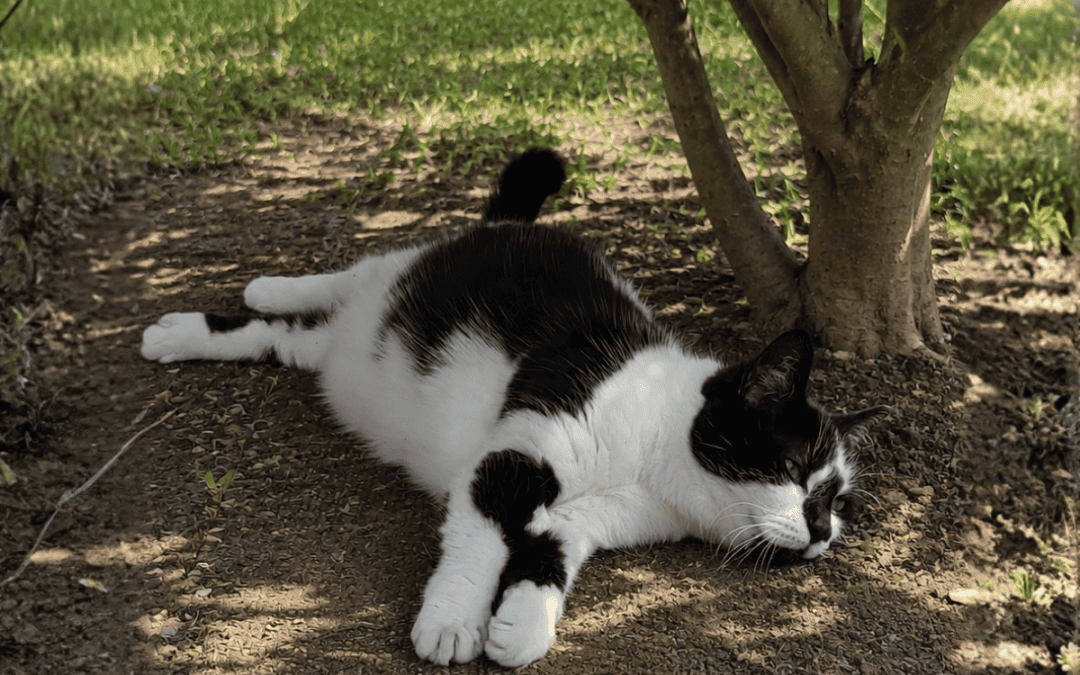
And then there’s the strategy that takes the least effort and works the best: going still. Cats are remarkably good at recognising that movement generates heat, and rest doesn’t. So on a proper hot day, your cat slowing right down, sleeping more, and looking generally unbothered by the world isn’t them being lazy. It’s them doing the single most effective thing available to them.
Lilly’s version of this is the cool kitchen floor. The minute the house starts to warm up, she’s flat out on the tiles, looking thoroughly unimpressed by the heat and entirely unwilling to do anything about it beyond lying there. In the garden, she has a favourite patch of shaded soil under our miniature apple tree, especially once I’ve watered it, where the ground stays cool and slightly damp. She’ll happily spend an entire afternoon there and come back in looking very pleased with herself.
If your cat has a spot like that, the kindest thing you can do is leave it alone and let them use it.
The signs your cat is too hot
Because cats don’t pant the way dogs do, panting in a cat is a more serious signal than it is in a dog. A cat who is panting, especially if it doesn’t settle within a few minutes of moving somewhere cooler, should be taken seriously.
Early signs that your cat is struggling with the heat tend to be subtle:
- Seeking out cool surfaces more deliberately than usual (tiles, sinks, bathroom floors)
- Grooming more than normal
- Generally low energy, even by hot-weather standards
- Slightly faster breathing
These are worth a watchful eye and a cooler room, but they’re not yet an emergency.
More serious signs need a vet call straight away:
- Heavy or prolonged panting
- Drooling
- Bright red or very pale gums
- Wobbliness, disorientation, or stumbling
- Vomiting
- Collapse or not responding
If you see any of these, move your cat somewhere cool and shaded immediately, and call your vet while you do it. Don’t wait to see if it passes.
Water, Shade, And Other Ways To Keep Your Cat Cool In A Heatwave
Most of what your cat needs from you in a heatwave is less “doing” and more “providing the conditions, then getting out of the way.”
Water in more places than usual. Cats are notoriously fussy about water position, so a few bowls dotted around the house, away from food and the litter tray, tends to get used far more than one bowl in the usual spot.
Shade that actually moves with the sun. A shaded patch at 9am can be full sun by 1pm. If your cat has outdoor access, check the spot they like is still shaded at the hottest point of the day, not just first thing.
A cool room indoors. Curtains closed on the sunny side of the house first thing in the morning keeps a room noticeably cooler for the rest of the day. Tile or wood floors, rather than carpet, give your cat the cool surface they’re instinctively looking for.
Resist the urge to wet them down unless they’re already struggling. Most cats are not keen on being deliberately made wet, and for a cat who’s simply warm rather than in difficulty, it tends to cause more stress than it solves. If your cat is actually showing signs of overheating, a cool (not cold) damp cloth on the paws, ears, and tummy is the gentler approach, while you get them to a vet.
What to do about play in this weather
This is the bit most advice on how to keep your cat cool in a heatwave skips, and it’s worth a mention. A bored cat doesn’t go looking for trouble the way a bored dog might, but enrichment still matters, even in the heat. It just needs to look different for a few days.
Skip anything that gets your cat properly moving, the kind of laser-chasing, full-pounce, up-and-down-the-stairs play that’s normally so good for their inner hunter. In this heat, that kind of exertion works against them, not for them.
Low-effort enrichment is the better trade for now. Food puzzles, a slow sniff around a cardboard box, or a gentle, low-key game that lets your cat engage without raising their temperature all scratch the same itch without the physical cost. If your cat does want to play properly, the cooler hours either side of the hottest part of the day are the better window, much like with the timing principles in our guide to when cats actually want to play.
If your cat shows zero interest in playing at all this week, that’s completely normal too. Let them opt out. Their inner wild cat knows exactly what it’s doing right now, and conserving energy is the instinct, not a sign that something’s wrong.
When to call the vet
Trust your instincts here, that’s most of what keeping your cat cool in a heatwave really comes down to. If your cat seems off in a way that doesn’t fit the “just a bit warm and slow” pattern, especially with any panting, drooling, wobbliness, or collapse, don’t wait it out. Cats are good at hiding when something’s wrong, which means by the time symptoms are obvious, things have usually moved along further than you’d like. A call to your vet costs you a few minutes. Waiting can cost a lot more.