
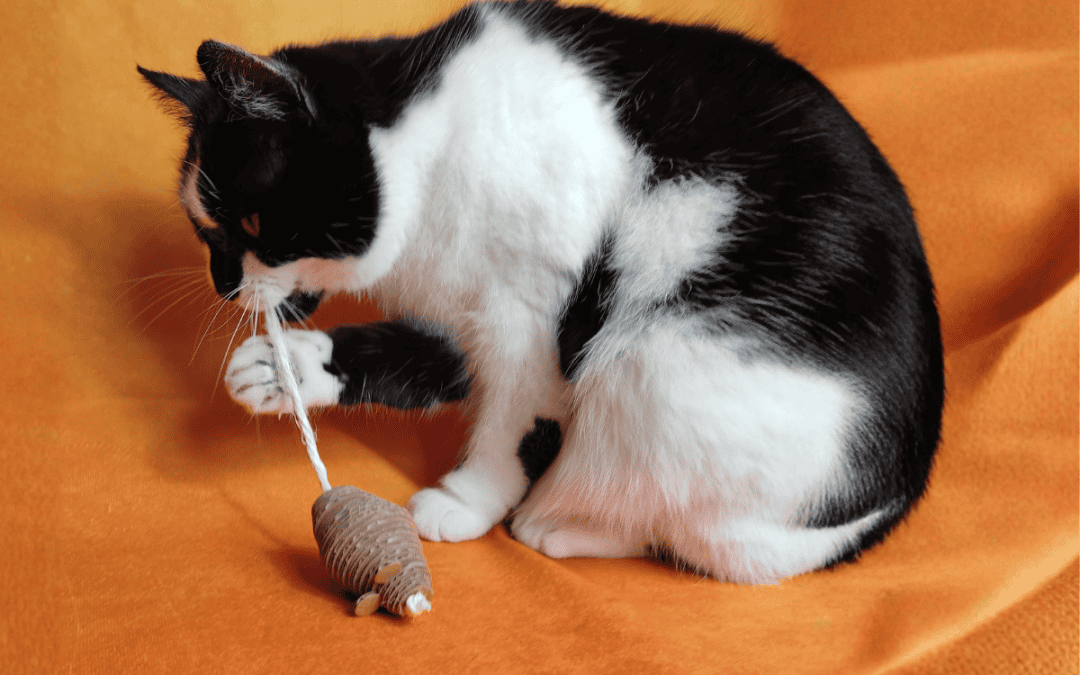
You’ve tried the toys. You’ve waved the feather wand. You’ve spent more time thinking about play time with cats than you ever expected to, and yet there’s your cat, watching from across the room with the energy of someone sitting through a PowerPoint they didn’t ask to attend.
And somewhere in the back of your mind, a small voice is asking: is my cat okay? Am I doing this wrong? Does my cat actually like me?
Here’s what I want you to know before we go any further: your cat almost certainly does want to play. They’re just wired differently to how we expect. And once you understand how they’re built, play stops being a thing you try to make happen and starts being something that just does.
What Times Do Cats Play?
This is one of the most searched questions about cat behaviour, and the answer is simple: adult cats play most at dawn and dusk. Everything else flows from that.
Adult cats are hardwired to be most active at dawn and dusk. Those are the hours when their prey would be moving, and even the most domesticated, biscuit fed house cat still carries that ancient rhythm in their bones. If your cat goes slightly feral at 6am or appears like a small furry missile just as you’re sitting down for the evening, that’s not chaos. That’s biology.
I spent weeks trying to get Lilly interested in play in the middle of the afternoon. She’d look at me with the mild tolerance of someone sitting through a work meeting that could have been an email.. Then I started playing in the early evening instead and she showed up like she’d had the appointment in her diary the whole time.
Same cat. Same toys. Different hour. Completely different result.
Kittens are the exception, they cycle through eating, sleeping and bursts of chaos all day long without much pattern. Most cats settle into the dawn and dusk rhythm somewhere around 12 months.
How Often Should I Play With My Adult Cat?
The ideal is two play sessions a day. Morning and evening tends to work well, which conveniently lines up with when your cat is already primed and ready.
But here’s the thing most people don’t know: length matters far less than consistency.
Five to ten minutes is genuinely enough for most adult cats. They’re not built for long, sustained activity they’re built for short, intense bursts, followed by rest, followed by pretending they were never that interested in the first place. Sound familiar?
Short daily sessions will do far more than the occasional long play marathon. The other thing worth knowing: cats don’t ask. They don’t nudge your hand or bring you a toy. They just wait. Quietly. Patiently. While you assume they’re fine and scroll your phone.
It’s easy to read that stillness as disinterest. It’s usually just uncertainty.
Why Play Isn’t Working (And What To Do About It)
When Lilly first came home, I assumed I was doing something wrong. I’d wave toys at her. She’d watch politely, very little happened.
Then one evening a toy slid under the sofa by accident.
She froze. She crouched. She pounced with a commitment she had never once shown for anything I’d deliberately offered her.
That was the moment I understood. She didn’t want things floating vaguely in the air. She wanted movement that felt like something worth chasing low, unpredictable, real. She wasn’t bored or broken or indifferent. She was waiting for play that made sense to her.
After that I changed how I moved the toy, not which toy I used. Along the floor instead of overhead. Disappearing behind furniture. Slower, then fast, then still. A bit of mystery. A pause before the pounce.
She went from watching to hunting inside a week.
If play isn’t landing with your cat, before you buy anything new try moving differently. The instinct is in there. You just have to speak its language.
- Keep movement low and along the ground rather than in the air at face level.
- Let toys vanish behind or under things, the disappearing act is half the fun.
- Slower and more deliberate often works better than fast and frantic.
- A pause mid play can trigger the pounce better than constant movement.
Why Routine Matters More Than You’d Think
Once I understood how to play, the next thing that changed everything was when we played consistently.
Cats thrive on predictability in a way that goes deeper than preference. When play happens at roughly the same time each day, they start to anticipate it. And anticipation is where engagement begins.
Random play can feel confusing. Predictable play feels safe and worth showing up for. Within a couple of weeks of keeping to a rough routine, Lilly started appearing at the right time, ready. Not because I’d trained her. Because she’d learned that play was reliably on offer, and she trusted it.
That trust is the thing. Once your cat believes play is coming, they meet you halfway.
How Play Changes As Cats Get Older
As cats age, play naturally becomes shorter and calmer. The dramatic leaps get less dramatic. The sudden bursts of 3am chaos slow down. That’s completely normal and it doesn’t mean the desire to play has gone.
Older cats often respond better to gentler movement and shorter sessions. Meeting them where they are, rather than where they used to be, keeps play enjoyable for both of you and keeps it going for longer.
Play Time With Cats Is Also About Connection
It’s easy to think about play in terms of exercise. Enrichment. Ticking a box on the responsible cat owner checklist. And it is all of those things.
But it’s also something quieter.
When you play with your cat, you’re paying attention to each other. You’re learning how they move and what makes them come alive. You’re building a kind of fluency an understanding of this small, strange creature who has chosen, in their own baffling way, to share your sofa.
Over time, that matters. Not in a dramatic way. In the way that trust always builds quietly, through small repeated moments, until one day you realise your cat is showing up for play before you’ve even reached for the toy.
Five minutes a day. That’s all it takes to start.
The Short Version
Your cat isn’t broken, and you’re not failing them.
Play works when it matches how cats are actually wired: at the right times of day, with movement that makes instinctive sense, done consistently enough that your cat learns to expect it.
Stop trying to make your cat play your way. Learn how they’re built. Then meet them there.
Most cats want to play. They’re just waiting for it to make sense.
If you’re looking for toys that actually work with your cat’s instincts rather than against them, every Cativity Box is hand-picked with exactly that in mind so you can stop guessing and start seeing what your cat actually responds to. Take a look at what’s inside.
About the Author
Angela is the founder of Cativity Box, a UK small business dedicated to cat enrichment. She hand-picks every product in her boxes based on how cats are actually wired their instincts, their play styles, and yes, their frequently baffling preferences. She’s been researching cat enrichment for years, mostly at floor level, with a feather toy and a very opinionated cat called Lilly.