
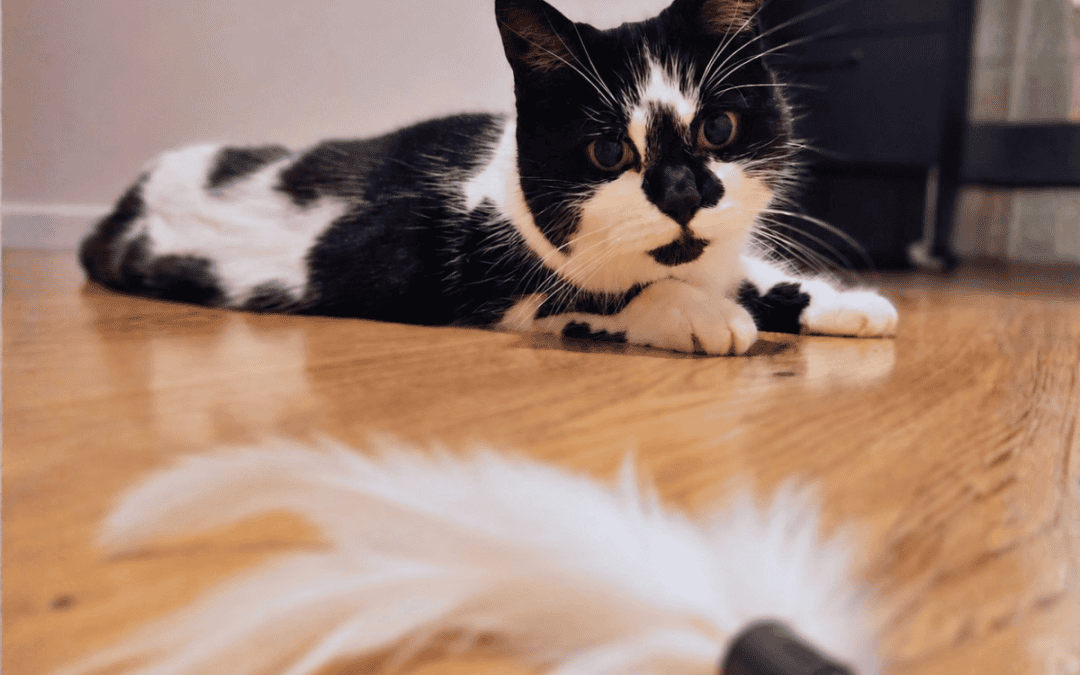
I get asked this at almost every market I go to.
Someone picks up a toy, turns it over in their hands, and then looks at me a little sheepishly. My cat doesn’t really play. And then, almost always, the same thing underneath it: I’ve tried. They just don’t seem interested in me.
That last part is the bit that gets people. It’s not really about the toy, is it? It’s about wanting your cat to come alive and feeling a bit helpless when they don’t.
I used to feel exactly that way about Lilly.
Here’s what I’ve learned. And what I tell people at markets, usually while they’re still holding the toy.
Play Is Hunting. And Hunters Have Office Hours.
Play isn’t leisure for a cat. It’s hunting. Every stalk, every pounce, every moment of loaded stillness before the strike is not your cat mucking about with a feather wand. That’s instinct. Old, precise, and very much still running in the background of your biscuit-fed, sofa-hogging companion.
The thing is, that instinct doesn’t run all day.
Try to engage your cat’s inner hunter at two in the afternoon and you’ll get the polite-but-vacant stare of someone sitting through a meeting they didn’t ask to attend. Try in the early evening, when cats are hardwired to be most active and their hunting instincts are naturally firing up, and you might find a completely different animal waiting for you.
Same cat. Same toy. Different hour. Completely different result.
The Thing That Actually Changes Everything
Timing helps. But this is the part that actually makes the difference, and the one that surprises people most when I explain it at markets.
It’s not just about when you play.
It’s about playing at the same time. Every day.
When play happens consistently, your cat starts to anticipate it. They begin showing up before you’ve reached for the toy, not because you’ve trained them, but because they’ve learned the hunt is reliably coming. And a cat that trusts play is coming will meet you halfway.
Before I cracked this with Lilly, evenings were hit and miss. Some nights she’d engage, most nights she wouldn’t. Two weeks of playing at roughly the same time each evening and she was waiting for me. Quietly. Near the toy. Pretending she’d just happened to be passing.
That’s what routine does. It turns play from something you try to make happen into something your cat is already expecting.
Same time. Every day. That’s the whole secret.
If It’s Still Not Landing
Consistent timing and it’s still not clicking? Look at how you’re moving the toy.
Cats don’t respond to things waved vaguely overhead. Their inner hunter wants movement that feels like real prey, low to the ground, darting behind furniture, disappearing, pausing, going again. The moment I started moving toys like prey rather than like a person trying to entertain a cat, Lilly stopped watching politely and started hunting properly.
Try this: keep it at floor level and let the toy vanish under something like a newspaper or magazine. Then wait. Then move it again slowly. Then fast. Then still.
Give it two weeks at a consistent time before you decide it isn’t working. Most cats come around sooner than you’d think.
You Haven’t Failed Your Cat
The reader I’m writing this for isn’t really looking for toy recommendations.
They’re the person at the market holding the feather wand, feeling quietly rejected because their cat won’t engage. They want their cat to enjoy life. To come alive. To choose play, and by extension, to choose them.
That’s not a product problem. That’s a conditions problem. And the good news is, the conditions are fixable.
Your cat’s inner hunter isn’t gone. It’s just waiting for the right moment, repeated reliably enough to feel worth showing up for.
Start there. Same time tonight. Then again tomorrow.
This Is What Cativity Box Is For
Once the routine clicks and your cat starts showing up for play, the next question is whether the toys are actually doing their job.
Not all toys are built equal. A lot of them ask your cat to be interested in something that has nothing to do with how they’re wired. Cativity Boxes are different, every product is hand-picked to work with your cat’s instincts, not against them. Because a cat that’s given real hunting opportunities doesn’t need to be persuaded to play.
They just do what they were born to do.
Browse what’s inside a Cativity Box
About the Author
Angela is the founder of Cativity Box, a UK small business dedicated to cat enrichment. She hand-picks every product in her boxes based on how cats are actually wired, their instincts, their play styles, and yes, their frequently baffling preferences. She’s been researching cat enrichment for years, mostly at floor level, with a feather toy and a very opinionated cat called Lilly.